Contact Us Careers
Lung Cancer

Small cell lung cancer has a high malignancy and limited treatment options. Immunotherapy may be a promising approach

时间:2026-04-27 人气:

Small cell lung cancer (SCLC) is clinically characterized by high malignancy, rapid tumor growth, early widespread metastasis, and frequent mediastinal involvement. Apart from being sensitive to chemotherapy and radiotherapy, there are no other more effective treatment methods. Patients often have a relatively short survival period, making the treatment different from that of other lung cancers. Today, we present a case of a SCLC patient who underwent NKT cell immunotherapy. Currently, the patient has achieved a stable phase of up to 15 months, with no recurrence or metastasis during this period, and is expected to continue to surpass the 2-year survival mark

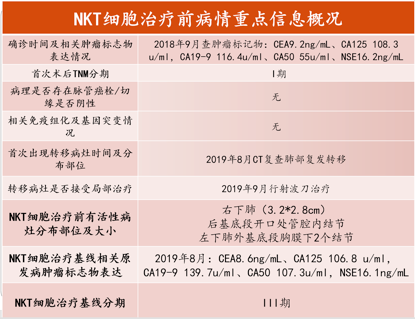
Mr. Gao, the patient, was found to have an elevated tumor marker during a physical examination in April 2014. However, no obvious abnormalities were observed on imaging. Subsequently, he underwent continuous testing for 4 years, and although the tumor marker gradually increased, no space-occupying lesion was still observed on imaging.
Until September 2018, a space-occupying lesion was found in the right lower lung and surgical treatment was performed. The pathological results were: small cell neuroendocrine carcinoma, moderately to well-differentiated, without invasion of the lung membrane, and no lymph node metastasis (0/5 and 0/1, respectively).
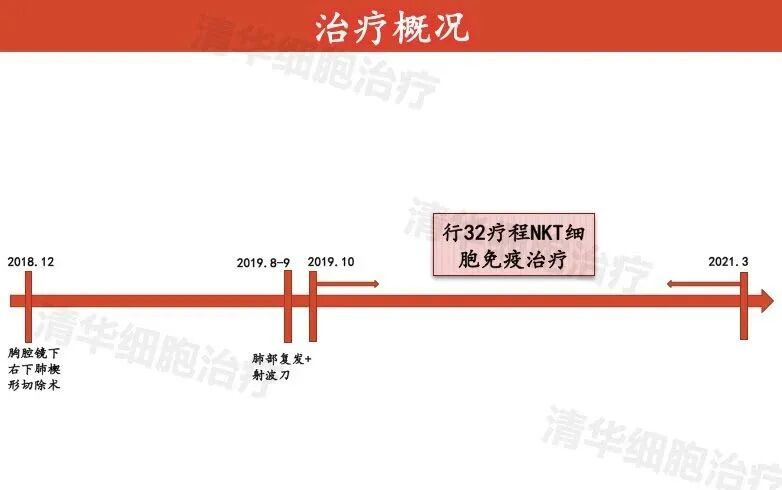
However, considering the patient's advanced age, adjuvant treatments such as chemotherapy were not administered. Ten months later, a new mass measuring approximately 3.2*2.8cm was found in the surgical area, suggesting recurrence and metastasis. Additionally, two new nodules were found in the left lower lung, along with a small amount of encapsulated pleural effusion. CyberKnife treatment was then administered.
After measures to reduce tumor burden were implemented, the patient immediately underwent NKT cell immunotherapy. However, due to the high malignancy and active nature of small cell lung cancer, the patient was treated with an intensified regimen, consisting of two courses per month.

 
After undergoing a continuous systematic treatment of 32 courses, and 3 follow-up visits and imaging examinations, no significant signs of tumor progression were observed:
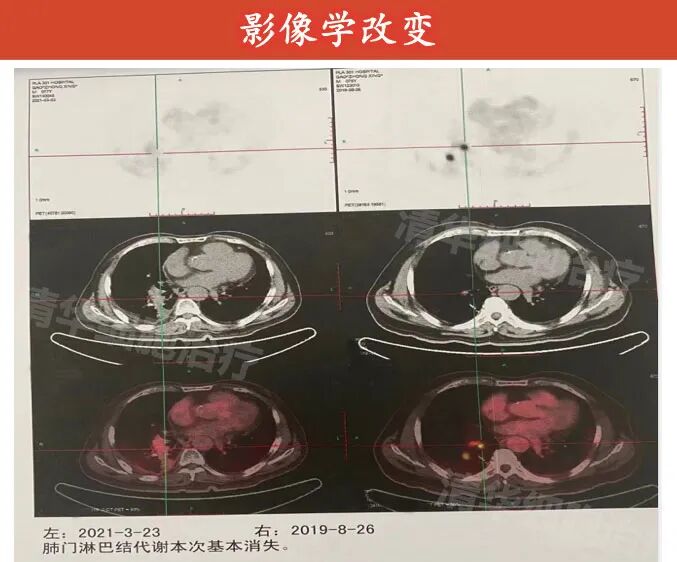
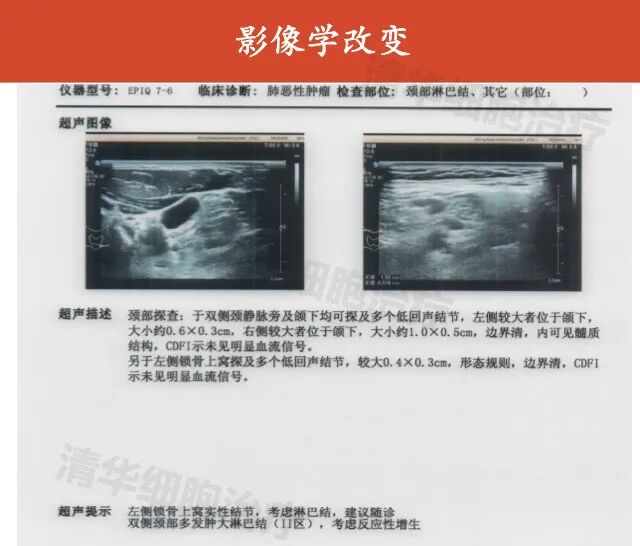
On March 23, 2021, a follow-up whole-body PET-CT scan showed a significant decrease in radioactive uptake compared to the scan on December 18, 2019, indicating that tumor activity had essentially disappeared. Continued close observation is recommended; Head MRI, cervical lymph nodes, and upper abdominal CT as well as whole-body PET-CT examinations revealed no obvious signs of metastasis. Tumor markers:
On October 11, 2019, compared to August 21, 2019, indicators such as CEA, Cy21-1, CA125, and NSE decreased, with NSE falling to the normal range. Weight and diet remained normal, and physical strength and sleep improved compared to before.

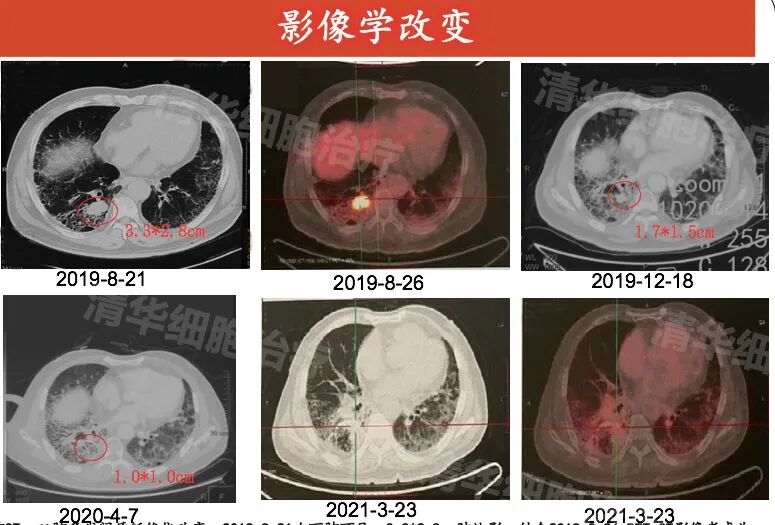
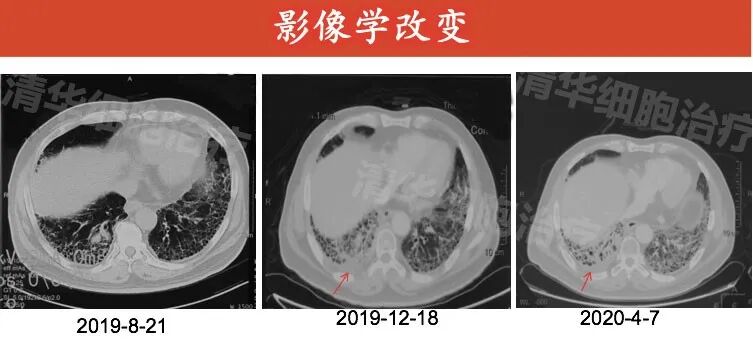
Lung CT: Multiple interstitial fibrosis changes in both lungs, with a 3.3*2.8cm mass shadow visible in the right lower lung on 2019-8-21. Combined with PET-CT imaging on 2019-8-26, it is considered to be a metastatic lesion. On 2019-12-18, the mass shadow gradually shrunk until 2021-3-23. Combined with the history of cyberknife treatment, it is considered to be a post-treatment change. On 2021-3-23, a PET-CT was performed, showing a significant decrease in radioactive uptake compared to 2019-12-18, with tumor activity essentially disappearing. Close observation is recommended.

Lung CT: A small amount of pleural effusion is visible in the right lower lung. On 2020-4-7, a follow-up examination showed slight absorption of the pleural effusion compared to 2019-12-18. Close observation is recommended.

Classic NKT Case Review

Click on the image

to view