Leave your message or request below and we will get back to you as soon as possible.
vNKT clinical trial · patient screening form
We are conducting a clinical study on vNKT immunotherapy. This form is for preliminary screening only; saving it does not mean enrollment. Information is used for screening only; separate informed consent will be signed before formal enrollment.
Part 1: Basic information
2. Sex
years
4. Nationality
Part 2: Disease and medical history
9. Treatments received (multiple choice)
10. Performance status (ECOG reference)
Part 3: Initial screening criteria
11. Are you 18 years of age or older?
12. Are you willing to participate and able to sign informed consent?
13. Known severe allergy, especially to biological products or monoclonal antibodies?
14. Active, uncontrolled severe infection (e.g. HBV, HCV, HIV, syphilis)?
15. Severe uncontrolled cardiac disease (e.g. NYHA III–IV), lung disease, or other major organ dysfunction?
16. Active autoimmune disease or need for systemic immunosuppression?
17. Pregnant or breastfeeding?
18. Participated in another drug or device trial within the past 6 months?
Part 4: Self-report and additional information
20. What do you hope to achieve through this immunotherapy study? (multiple choice)
Tip: For extensive records, you may contact the clinical study coordinator to submit pathology, imaging, or discharge summaries.
Why would anyone be willing to sit and wait for recurrence and metastasis when treating synovial sarcoma?
时间:2026-04-27 人气:
If you cannot understand the subsequent professional description,
you can finish reading this text in two minutes

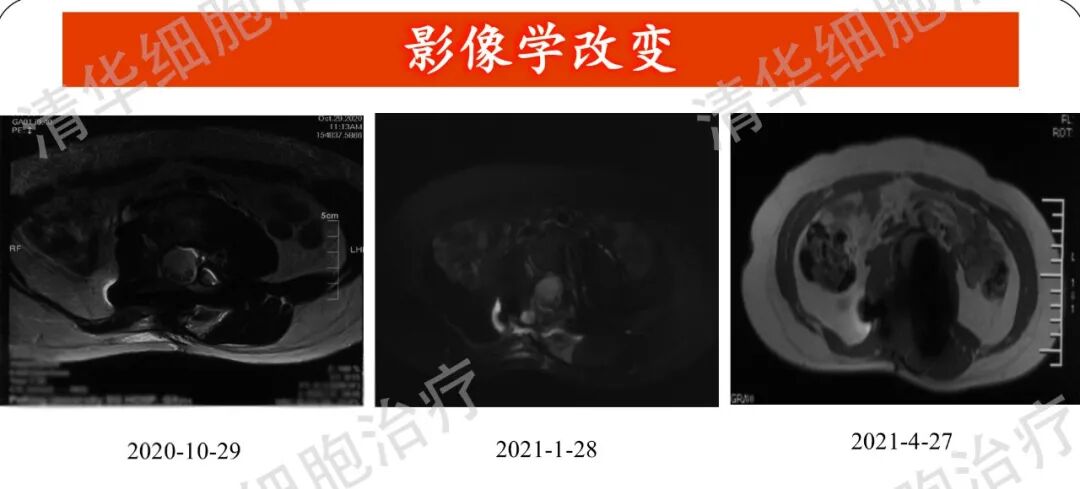
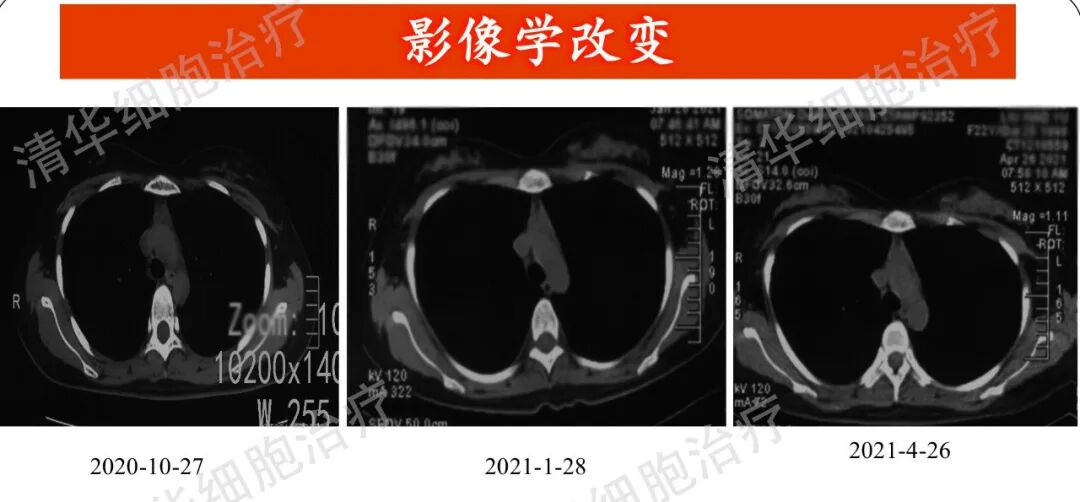
In mid-February 2020, Ms. Liu accidentally touched a mass on her right waist, about the size of a Mantou. She then visited a local hospital, where preliminary examination found that the mass was painless and had poor mobility. "Painless and poor mobility"is a relatively dangerous description, indicating a high possibility of malignancy. In addition to imaging examinations, confirmation through pathological biopsyis also necessary. Subsequent biopsy of the lesion confirmed synovial sarcoma. The tissue origin is synovium. From March to April 2020, two cycles of chemotherapy were immediately administered, using the regimen of adriamycin + dacarbazine + ifosfamide. After the first chemotherapy session, the mass significantly shrunk, but there was no significant change after the second session. Subsequently, AI-based chemotherapy was administered . In May 2020, lumbar tumor resection and internal fixation were performed at Peking University First Hospital. Post-surgery, three cycles of chemotherapy with dacarbazine + ifosfamide + liposomal paclitaxel were administered. Traditional treatment has temporarily come to an end, and the usual approach is to only start the next stage of treatment when the tumor recurs and metastasizes. However, no patient would be willing to sit at home waiting for recurrence and metastasis to begin a new round of various treatments! Is there a way to intervene in advance to reduce the probability of recurrence and metastasis, or even prevent them altogether? Sarcomas originating from mesenchymal tissue are relatively rare among malignant tumors. Sarcomas have a short survival period and are prone to metastasize to the lungs or other organs. Traditional treatment options have shown little effect, and patients, after undergoing various treatments, not only face significant economic burdens but also often suffer from severe physical damage caused by drugs. Ms. Liu was very worried and actively sought other methods online. After hearing about Professor Zhang Minghui of Tsinghua University and his NKT cell therapy technology, she researched many cases in detail and found that many patients who aimed for prevention had remained problem-free for over 5 years! This fact gave Ms. Liu great confidence and she contacted our team. After a detailed understanding of her condition, we developed a treatment plan for Ms. Liu with one course per month. Treatment began in August 2020 and has continued to date, with 11 courses completed (as of July 2021). There has been no evident tumor progression, and the evaluation is stable. Imaging-wise: Chest CT scans from October 2020 to April 2021 showed no significant abnormalities; lumbar MRI scans from October 2020 to April 2021 revealed edema in the bilateral erector spinae muscles without evident tumor signs, considered to be post-operative changes. A follow-up whole-body PET-CT scan in August 2021 showed no signs of recurrence or metastasis.
▲Lumbar M-spinal muscle still shows edema, with no obvious tumor signs. On April 27, 2021 (T2WI axial), no obvious tumor signs were observed. Currently, it is considered to be a postoperative change.
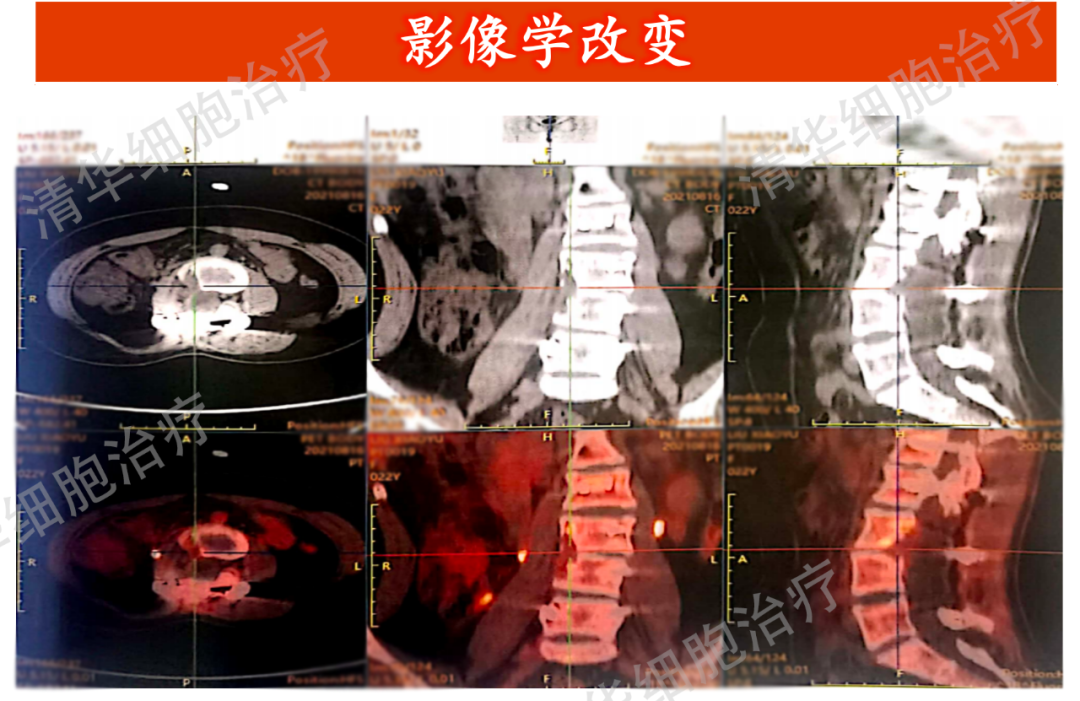
▲PET-CT (August 16, 2021): After treatment for lumbar synovial sarcoma, high-density implants were observed in the surgical area, with good alignment and no obvious loosening. FDG metabolic activity increased near the transverse process around the metal fixation, which is considered to be an inflammatory reactive change. Local vertebral postoperative changes were observed, with no obvious increase in FDG metabolism, indicating no clear signs of tumor recurrence.
▲Lung imaging findings: Residual thymus was visible, with no other abnormalities or metastasis observed. Quality of life: During the one-year treatment, Ms. Liu's physical condition significantly improved, with better appetite and sleep, increased body weight, resuming normal work, and excellent mental state. Her quality of life score was 91.5. Ms. Liu underwent surgery in May 2020 and began NKT cell immunotherapy on August 28, 2020. Currently, her disease-free survival (DFS) has reached 17 months. For malignant tumors such as lumbar synovial sarcoma, which have a high recurrence rate and short survival period, Ms. Liu's treatment has been very effective.
Let's look forward to next year's follow-up presentation together.