About Lehe
乐于心,和与众,与己乐,与人和; 心宽念纯,百病无生。


乐于心,和与众,与己乐,与人和; 心宽念纯,百病无生。


If you find it difficult to understand the subsequent professional descriptions, you can finish reading this text in just two minutes. Mr. Chen is our regular patient, and we have demonstrated his treatment efficacy last year. (Click the link to view: 1. How to treat kidney cancer that is not sensitive to radiotherapy and chemotherapy and has developed lung and brain metastases? 2. Prioritizing immunotherapy makes advanced kidney cancer with brain metastasis less terrifying. 3. How to treat kidney cancer that is not sensitive to radiotherapy and chemotherapy and has developed lung and brain metastases?) Let's take a look at his condition this year. In March 2013, he presented with intermittent painless gross hematuria and was diagnosed with kidney cancer at the People's Liberation Army Army General Hospital. On March 21, 2013, he underwent radical nephrectomy via abdomen, and post-surgery, he received autologous DC tumor vaccine therapy. The treatment options for kidney cancer are relatively limited, mainly relying on surgery, and the efficacy of radiotherapy and chemotherapy is limited, with few targeted drug options. However, immunotherapy has consistently shown good results for kidney cancer.
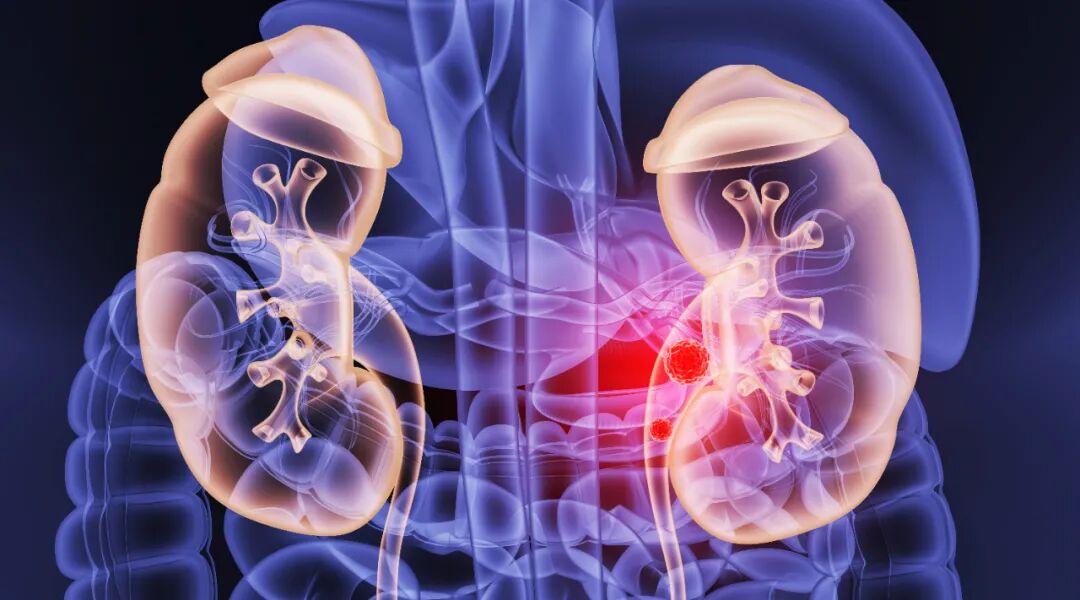
So Mr. Chen maintained a stable period of four years after surgery, but in October 2017, PET-CT revealed simultaneous metastasis in the right upper and lower lobes of the lung, as well as in the right occipital lobe! He immediately underwent gamma knife radiotherapy for some lung lesions and brain metastases at the People's Liberation Army Army General Hospital.
Although Mr. Chen also received radiotherapy for the metastatic lesions, two years later, in February 2019, a chest CT scan revealed a mediastinal metastatic tumor in the right upper lobe of the lung, with the lesion slightly larger than in the previous examination, indicating disease progression.
In fact, many advanced cancers have this characteristic: the time interval between recurrences and metastases becomes shorter and shorter. For example, in Mr. Chen's case, it took four years from surgery to the first metastasis, but the time to the second metastasis was shortened by half, to only two years. But who would be willing to face the third metastasis and calculate the interval between the third metastasis?
Traditional treatment methods cannot solve the dilemma of not wanting to see recurrence and metastasis again. After extensive inquiries and online searches, Mr. Chen found Professor Zhang Minghui from Tsinghua University School of Medicine and learned that many patients who have undergone NKT treatment have achieved long-term progression-free survival (PFS). (Click the link to view  NKT case presentation ), so Mr. Chen decided to give it a try.
In April 2019, Mr. Chen began NKT cell immunotherapy, with a regimen of one course per month, and has completed 27 courses to date (as of September 2021).
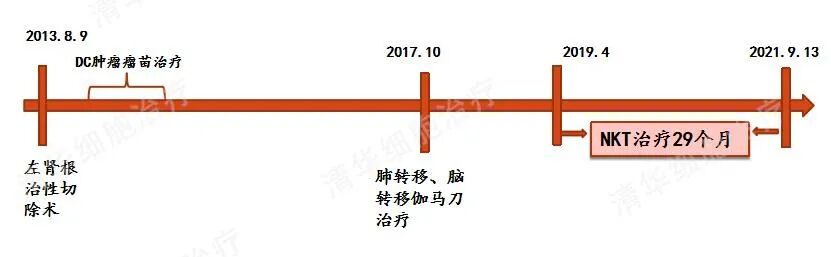
Nearly three years have passed now, and Mr. Chen has shown no signs of tumor progression, proving that his initial choice was correct! Let's take a look at this year's follow-up results.
Imaging Findings
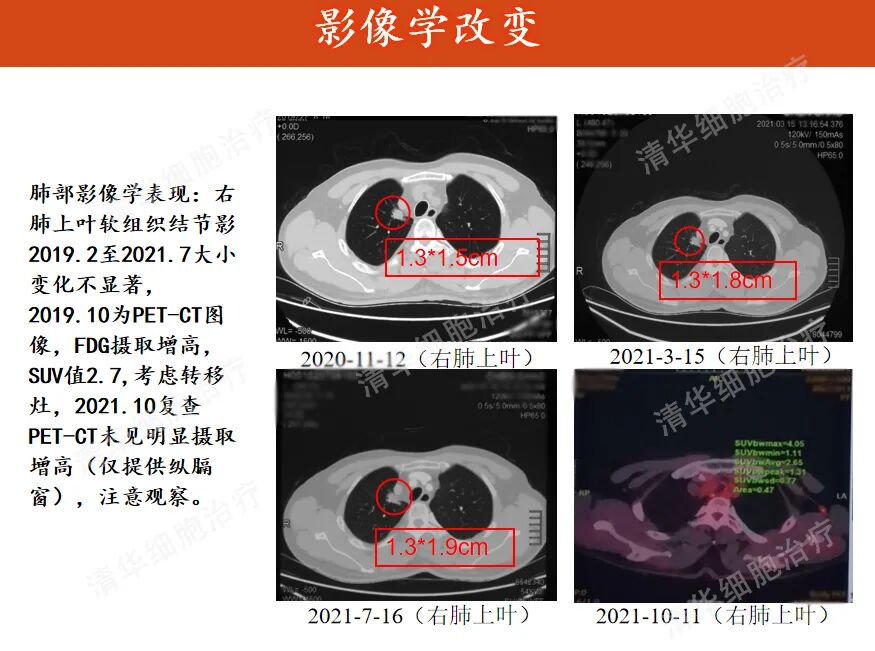
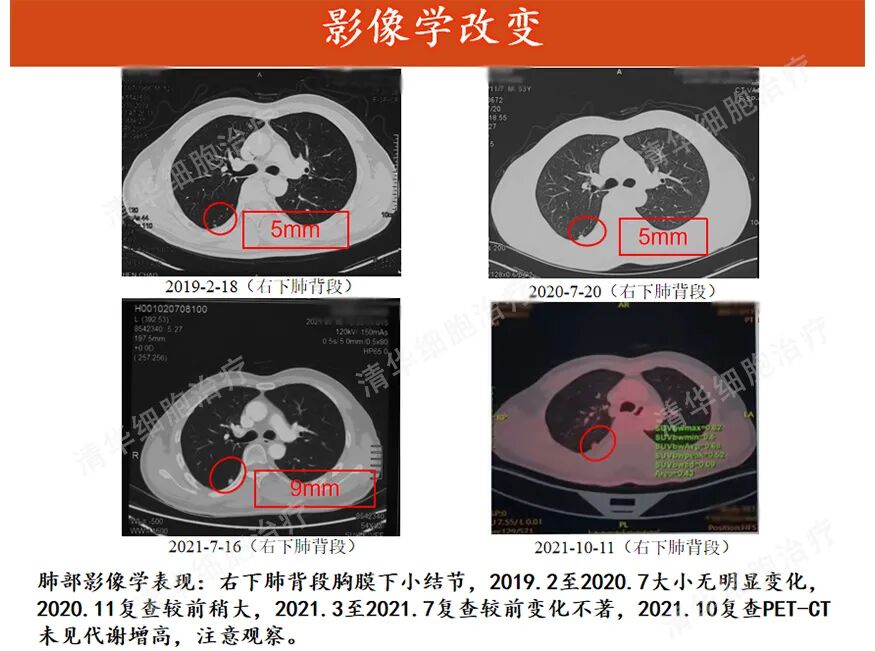
Chest CT imaging revealed no significant changes in the nodules in the right upper lobe from February 2019 to September 2021. There was a patchy increased density shadow in the right lower lobe, with no significant change in size from February 2019 to July 2020and a slight increase in size during the follow-up in March 2021 compared to November 2020, suggesting possible chronic inflammation, which requires close observation. There was also a small nodule beneath the pleura in the dorsal segment of the right lower lung, with no significant change in size from February 2019 to September 2021.
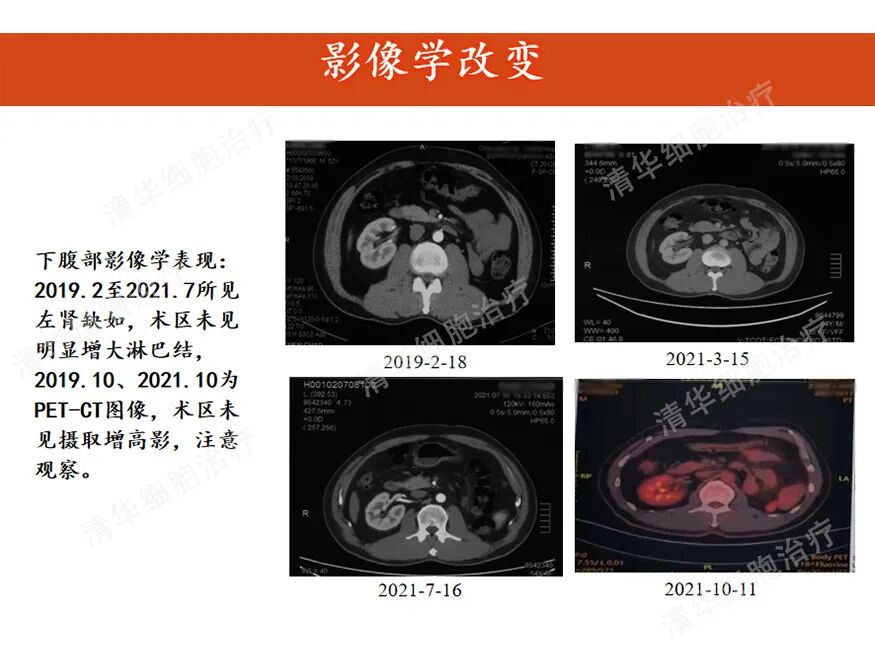
Regarding tumor markers
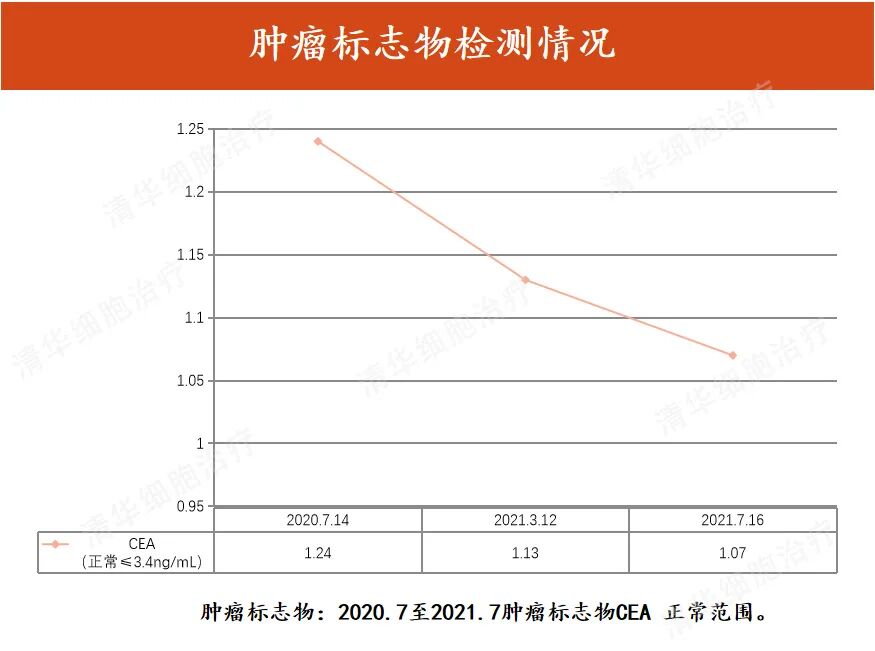
and quality of life
After NKT treatment, during this follow-up visit, Mr. Chen was energetic, sleeping well, and had a good appetite. His physical strength had improved compared to before. He had no difficulty walking up to the sixth floor, and his quality of life score was 89 this time.
Mr. Chen was diagnosed with kidney cancer in 2013 and underwent timely surgery. More than four years after surgery, he developed brain and lung metastases. Gamma knife local treatment was performed on the metastatic lesions in the head and part of the lung. Upon reexamination, the lesion in the right upper lobe was found to have enlarged compared to before, so immunocyte therapy was administered to control tumor progression. After undergoing continuous30months ofsystemic treatment, 9 follow-up visits, and imaging examinations, no significant signs of tumor progression were observed. This is a very optimistic result for a patient who has developed both lung and brain metastases.
NKT Classic Case Review
Click on the image
to view


Address: Room 1101 (Unit 101), 11th Floor, Building 1, No. 7 Courtyard, Kexueyuan Road, Life Science Park, Changping District, Beijing
Phone:010-8265 9866
Email:lehemedneo@hotmail.com